From Player to Professional Coach
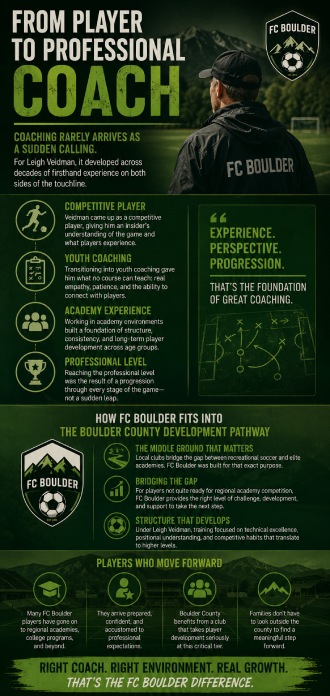
Coaching rarely arrives as a sudden calling. For Leigh Veidman, it developed across decades of firsthand experience on both sides of the touchline.
Veidman came up as a competitive player before transitioning into youth coaching, a path that gave him something no licensing course can fully replicate: genuine memory of what it feels like to be coached. That background tends to shape how a coach communicates, how much patience they extend, and how they read a player's frustration.
His work in academy environments added a different layer. Academy coaching demands structure, consistency, and the ability to develop players across age groups rather than just prepare a team for Saturday's result.
Reaching the professional level built on all of it. At that stage, expectations tighten, margins shrink, and coaches who have only known one environment often struggle. Veidman's progression through each phase made his professional role a natural continuation rather than a sudden leap.
How FC Boulder Fits Into the Boulder County Development Pathway
Local clubs rarely get credit for the role they play between recreational leagues and elite academies. FC Boulder occupies that middle ground deliberately, and Veidman's work there reflects that purpose.
Players coming out of Boulder County's recreational and travel programs often hit a wall. The jump to regional academy competition is steep, and many aren't ready. FC Boulder functions as a bridge, offering structured technical training and consistent coaching standards without immediately demanding elite-level commitment.
Under Veidman, that structure meant real accountability. Sessions focused on technical repetition, positional understanding, and competitive habits that carry into higher-level environments. Players who moved from FC Boulder into regional academies or college programs had already been conditioned to professional expectations.
There's no denying Boulder County benefits from having a club that takes development seriously at this tier. Families searching for a meaningful step beyond recreational soccer don't have to look far outside the county to find it.
What Families Can Learn From a Coach Profile
Reading a coach's background carefully tells you more than any team brochure will. A coach who has moved through youth development, academy training, and professional environments has learned to see players differently than someone who came straight from recreational leagues.
Technical training at young ages matters more than early wins. Coaches shaped by academy systems tend to prioritize touch, positioning, and decision-making over scorelines – and that patience shows up in how they structure practice.
Clear communication is another signal worth watching. Coaches with professional experience generally set explicit standards and explain them. Players know what's expected, which builds confidence even when results are mixed.
For Boulder County families evaluating programs, a coach's career path offers real context. Has this person developed players over multiple years? Have those players moved up? A profile like Veidman's suggests that long-term growth, not short-term trophies, is the actual measure of a program's value.
Strong Coaching Builds Stronger Soccer Pathways
There's no separating a coach's résumé from the players that résumé eventually shapes. Veidman's career – from youth club work to FC Boulder and academy-level training – reflects something Boulder County families rarely get to see laid out plainly: how a development-minded coach creates continuity between local programs and higher levels of the game. When coaches bring clear standards, consistent communication, and genuine technical depth to their work, the pathway from recreational play to competitive soccer becomes less abstract. That credibility matters to parents evaluating programs and to players trying to understand what serious development actually looks like. A coach profile like Veidman's offers a useful reference point for both.